
Intelligent network monitoring and AI-assisted troubleshooting are opening up new possibilities in the operation of IT infrastructure in modern buildings and companies. Imagine a modern office building where hundreds of devices are connected to the same network infrastructure. Computers, servers, Wi-Fi access points, IP cameras, access control systems and various smart building management devices are all running at the same time. For employees, all of this is taken for granted. They arrive in the morning, switch on their computers, connect to the network, and the working day begins. But what happens if one element of the network fails?
And, more interestingly: what if the system could warn us about certain problems before a failure even occurs?
THE NETWORK IS NO LONGER JUST ABOUT IT
In the past, the primary job of a corporate network was to connect computers and servers.
Today, however, more and more building management and security systems also rely on the network infrastructure.
Just think of a few examples:
IP camera systems: cameras transmit their footage over the network to recording and monitoring systems.
Access control systems: communication between controllers and central software often takes place over a network connection.
Wi-Fi networks: they keep office, industrial and guest networks running.
Smart building automation: various sensors and controllers can communicate with each other over the network.
Corporate IT systems: servers, storage systems, workstations and business applications are all interconnected.
A network problem, therefore, no longer simply means that a website loads slowly for someone. In some cases, it can affect the operation of several building systems.
THE NEW DIRECTION: THE NETWORK CONTINUOUSLY MONITORS ITS OWN HEALTH
One of the most important advantages of modern network monitoring systems is that they do not only provide information once a fault has already occurred.
A properly designed infrastructure can continuously collect data on, for example: the availability of network devices, link utilisation, traffic patterns, packet loss and response times, the performance of network devices, and unusual operating events.
Even traditional monitoring solutions can generate useful alerts from this data.
AI-assisted systems offer further possibilities for analysing it.
HOW CAN ARTIFICIAL INTELLIGENCE HELP?
Let’s assume that one link in a corporate network is under heavy load every weekday morning. That in itself is not necessarily a problem – it may simply be when the working day starts. But if the same link shows a significant increase in traffic at an unusual time, that may warrant investigation. A more advanced network monitoring solution may be able to recognise such deviations.
One of the key roles of AI may be precisely to help distinguish between normal operation and events that genuinely deserve attention. AI-assisted network monitoring can be useful in several areas.
1. Detecting unusual network events
The system can analyse historical traffic data and flag when a network device or link behaves significantly differently from usual. This can help operators identify problem areas more quickly.
2. Early detection of performance degradation
A network link does not necessarily become unusable from one moment to the next. At first, response times may increase, packet loss may rise, or a device may start running under persistently high load. The right monitoring system can detect these changes before a complete service outage occurs.
3. Faster troubleshooting
In a larger network, the hardest part is often not detecting the fault itself, but finding its cause. The problem may stem from a faulty device, an overloaded link, a configuration discrepancy or even a physical network fault. Intelligent analytics systems can help correlate different events and suggest possible sources of the fault. This can make operators’ work significantly easier.
CAN EVERY NETWORK FAULT BE PREVENTED?
Of course not. An unexpected power cut, physical cable damage or sudden hardware failure cannot always be predicted. It is important to distinguish between continuous monitoring, anomaly detection and the actual prediction of failures.
Intelligent network monitoring does not promise fault-free operation, but it can provide more information and the ability to respond faster. This can be especially valuable in facilities where network availability is a fundamental operational requirement.
EVEN THE SMARTEST SOFTWARE CANNOT REPLACE GOOD INFRASTRUCTURE
There is, however, one important detail that is often discussed less when it comes to new technologies. Even the most advanced network monitoring software is of little use if the underlying infrastructure is inadequate. A poorly designed structured network, untraceable cabling or incomplete documentation can make troubleshooting and operation considerably more difficult. That is why the following remain essential when building modern networks:
Proper network design. The infrastructure must be sized to the building’s current and anticipated needs.
High-quality structured cabling. A reliable physical network is one of the basic prerequisites for stable communication.
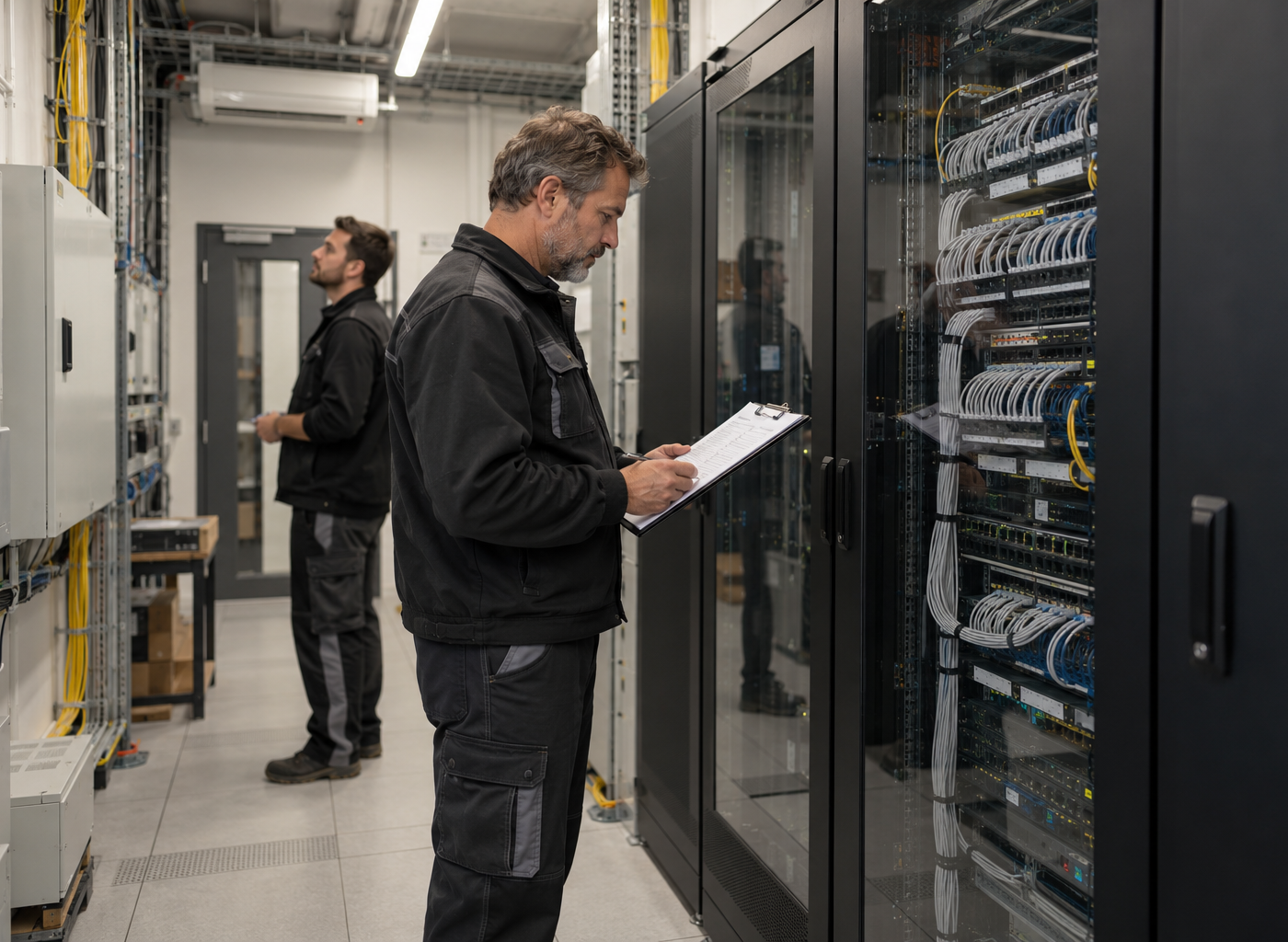
Clear, well-organised rack infrastructure. Tidy and properly labelled connections make maintenance easier.
Accurate documentation. In a larger system, it is especially important that operators know where each device is located and how it connects to the network.
Future expandability. With new devices and systems constantly emerging, it pays to plan capacity ahead. Intelligent network monitoring, therefore, does not replace professional installation – it builds on it.
WHY DOES ALL THIS MATTER TO INVESTORS AND FACILITY MANAGERS?
The low-voltage infrastructure of a modern building serves its users for many years. That is why, during the design phase, it is not enough to think only about handover day. Future operation, troubleshooting, system expansion and the ability to integrate new technologies are at least as important. A well-designed network infrastructure can make system monitoring easier, speed up fault identification, support future technological developments, contribute to more predictable operation, and provide a valuable foundation for the building’s operation in the long term.
The network of the future is therefore not only fast, but also transparent, manageable and scalable.
PLANNING A MODERN NETWORK INFRASTRUCTURE? WE CAN HELP YOU DELIVER IT!
I-Solution Kft. specialises in designing and installing complex low-voltage systems and structured IT networks. Whether it is a new development, an industrial facility, an office building or the modernisation of existing infrastructure, we believe the systems we install should not only handle today’s tasks, but also provide a solid foundation for future development. If you are planning a new network infrastructure or the modernisation of your existing system, get in touch with us!
I-Solution Kft. – Specialists in low-voltage solutions.